

Phoenix Commercial Leasing Guide: Tenant Strategy and Deal Terms
Choosing business space is rarely as simple as finding the lowest advertised rate. A location that seems affordable can become expensive once you account for build-out costs, operating expenses, renewal language, parking, and the flexibility your company needs two or three years from now.
Our Phoenix commercial leasing guide starts with a practical idea: lease the space that supports your operating plan, not just the space that looks good on a tour. Phoenix is a large, diverse metro, and the right fit for a Scottsdale office user may be completely different from the right fit for a Tempe retailer, a West Valley industrial tenant, or a medical practice serving nearby neighborhoods.
Phoenix Leasing at a Glance
| Decision Area | What to Evaluate | Common Misstep | Better Approach |
|---|---|---|---|
| Location | Access, visibility, labor | Choosing by rent alone | Map customers and staff |
| Lease structure | Base rent, NNN, utilities | Comparing unlike rates | Model full occupancy cost |
| Build-out | Scope, timing, allowance | Assuming work is included | Define work in writing |
| Flexibility | Renewal, expansion, exit | Ignoring future needs | Negotiate options early |
| Building fit | Parking, loading, power | Touring without a checklist | Match space to operations |
Phoenix office conditions have improved, but the story still varies by submarket and building quality. In the second quarter of 2026, CBRE reported 19.1% office vacancy and average asking rents of $32.30 per square foot. That data is useful context, not a substitute for comparing specific buildings, lease structures, concessions, and available suites.

Build the Requirement Before Touring Space
A strong leasing process begins before the first property tour. We recommend creating a one-page requirement list that describes how the business operates, who needs to reach the site, and what could change during the lease term.
Define the non-negotiables
Start with the operational details that can make or break a location:
- Target square footage, plus realistic growth room
- Desired submarkets and acceptable drive times
- Parking needs for staff, clients, fleets, or deliveries
- Visibility, signage, storefront access, and traffic patterns
- Loading, clear height, power, plumbing, ventilation, or specialized improvements
- Internet reliability and after-hours access
- Lease commencement date and move-in deadline
For a professional office, image, employee commute, and layout efficiency may lead the conversation. For retail, daily traffic, co-tenancy, signage, and parking may carry more weight. For warehouse and flex users, the loading configuration or yard access can be worth far more than a small difference in quoted rent.
Think through the next business chapter
Businesses often underestimate how quickly their real estate needs can change. Before committing, ask whether the space can support a larger team, a new service line, more inventory, or different customer behavior.
This is where renewal, expansion, contraction, and assignment rights matter. They may not affect the opening cost, but they can materially affect your leverage later. Our tenant representation services are designed to help clients evaluate those decisions from the tenant side of the table.
Compare the Right Type of Phoenix Space
A useful Phoenix commercial leasing guide separates property types before comparing rates. An office suite, a retail bay, a flex building, and medical space can have very different cost structures, construction needs, and deal timelines.
Office space
Office tenants should evaluate layout efficiency, common-area quality, building access, internet service, parking ratios, and the cost of any tenant improvements. Class A space may help with recruiting and client experience, while a well-located Class B building can offer better value for a company that prioritizes functionality over a trophy address.
Current office demand has been uneven across the Valley. Cushman & Wakefield noted that Phoenix office leasing activity reached 1.5 million square feet in the second quarter of 2026, while vacancy declined to 25.4% under its market methodology. That is a reminder to compare current availabilities locally, not rely on one metro-wide number.
Retail space
Retail leasing depends on what customers see and how easily they can stop. Review ingress and egress, monument signage, storefront visibility, nearby anchors, delivery access, exclusive-use protection, and the mix of neighboring tenants.
A lower rent in a hidden location can be a false economy for a business that relies on walk-in traffic. We also encourage retail users to visit prospective sites at different times of day and on different days of the week before committing.
Industrial, warehouse, and flex space
Industrial tenants need a building that works physically, not just financially. Confirm clear height, grade-level doors, dock positions, power capacity, truck circulation, storage rules, fire suppression, and permitted uses before investing time in lease negotiations.
Flex space can be an effective option for service businesses that need offices, light assembly, storage, and customer access in one place. The tradeoff is that well-configured flex space can be limited in the most active submarkets, so planning ahead matters.
Medical and specialized uses
Medical, lab, food, fitness, and education tenants should treat the build-out plan as a major business decision. Plumbing, electrical capacity, HVAC, accessibility, licensing, and city approvals can affect both cost and timing.
Do not assume a prior tenant's improvements can be reused. Have the space, plans, and lease language reviewed by professionals familiar with your use before signing.
Calculate Occupancy Cost, Not Just Quoted Rent
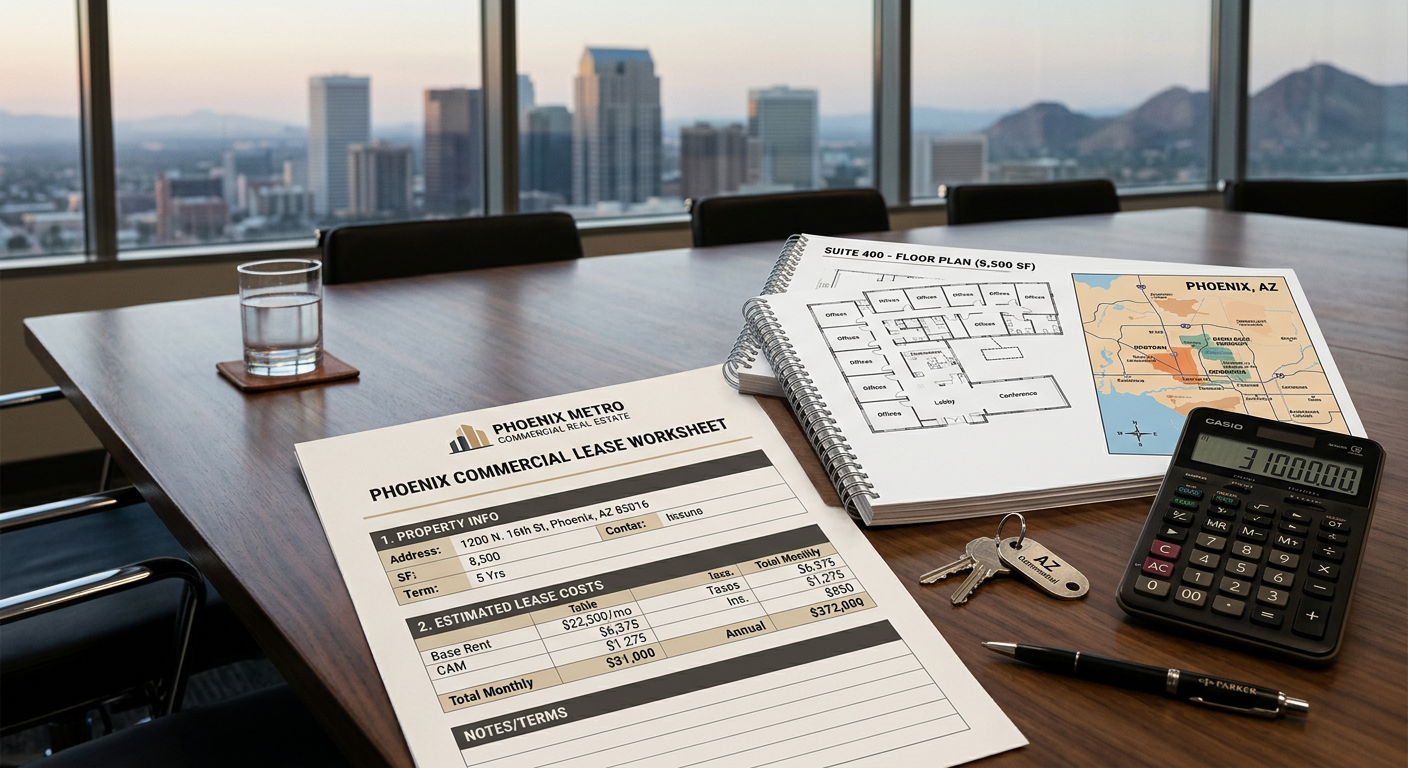
The advertised rate is only one line in the budget. To compare properties accurately, put each option into a complete occupancy-cost model that covers every recurring and one-time expense.
Understand the lease format
Commercial leases commonly use full-service gross, modified gross, or triple-net structures. The labels matter less than the actual allocation of expenses.
- Full-service gross: Rent generally includes many operating costs, though expense increases may still apply.
- Modified gross: The tenant pays base rent plus defined expenses, often utilities, janitorial, or annual increases.
- Triple-net: The tenant pays base rent plus a share of property taxes, insurance, and common-area maintenance costs.
Ask for a detailed expense history, current estimate, annual reconciliation process, and a clear explanation of what is excluded. A lower base rate with high pass-through expenses can cost more than a seemingly higher gross rate.
Budget for the costs that surprise tenants
Your model should include rent escalations, security deposit, utilities, janitorial, insurance, moving, furniture, data cabling, permits, legal review, and build-out overruns. If the space is not move-in ready, add a contingency and enough time for construction.
Tenant improvement allowances deserve particular attention. Clarify the allowance amount, eligible costs, disbursement timing, who owns the improvements, and what happens if the work costs more than expected. A larger allowance is valuable only if it matches the actual scope and can be used when you need it.
Negotiate the Terms That Create Real Leverage
A lease is a business contract with real consequences. The rent number matters, but several non-rent terms can be equally important over the life of the deal.
Focus on these deal points
Prioritize the provisions that shape your cost, flexibility, and ability to operate:
- Base rent, annual increases, and free-rent periods
- Tenant improvement allowance and construction responsibilities
- Lease term, renewal options, and renewal-rate language
- Expansion, contraction, assignment, and sublease rights
- Exclusive-use rights for retail tenants
- Signage rights and parking commitments
- Repair obligations, especially HVAC and major systems
- Personal guaranty scope and release conditions
- Delivery date, commencement date, and remedies for delays
We often see tenants focus on one concession and miss the larger economics. For example, a few months of free rent may not offset an unfavorable operating-expense cap, a restrictive guaranty, or a renewal option priced without a clear standard.
Create competition when possible
Even if you strongly prefer one building, evaluate alternatives. A credible set of options helps clarify pricing and gives you a more informed negotiating position.
Landlords also evaluate tenant strength, timing, intended use, and fit with the property. A complete proposal with financial information, operational details, and realistic timing can make your offer easier to approve.
For owners, this same discipline supports better retention and faster lease-up. Property owners evaluating an asset sale or repositioning strategy can also explore investment sales guidance alongside leasing decisions.
Match the Submarket to the Business
Phoenix is not one leasing market. The Camelback Corridor, Central Phoenix, Scottsdale Airpark, Tempe, Chandler, Mesa, Deer Valley, and West Valley each offer distinct labor pools, traffic patterns, building inventories, and customer bases.
A home-services company may value freeway access and a service radius more than a high-profile address. A client-facing financial firm may prioritize proximity to its customer base and a polished building environment. A retailer may need the right daytime population, nearby complementary uses, and parking that remains convenient during peak hours.
Location decisions can also affect nearby residential demand. Employers, medical users, retailers, and service businesses influence how people experience a neighborhood, which is one reason commercial activity matters to local buyers, sellers, and residential investors. You can follow broader local conditions through our Phoenix real estate research resources and recent market posts.
Questions Phoenix Tenants Ask Before Signing
How long should a commercial lease be?
The right term depends on your capital investment, business stability, and need for flexibility. A longer term can support more landlord concessions, while a shorter term can limit risk. We recommend weighing the value of concessions against the cost of being locked into the wrong location.
Should we renew or relocate?
Begin evaluating both paths well before your lease ends. A renewal may be efficient, but a market comparison can reveal whether the current landlord's proposal is competitive and whether another location would better support the business.
Who pays for tenant improvements?
The answer depends on the lease and negotiated work letter. Landlords may provide an allowance, deliver the space in a defined condition, or require the tenant to manage and fund improvements. Put every responsibility, deadline, and approval step in writing.
What does triple-net rent mean?
Triple-net rent generally means the tenant pays base rent plus its share of property taxes, insurance, and common-area maintenance expenses. Always request the estimated additional rent and review prior-year expenses before comparing it with a gross-rent proposal.
Do we need a tenant representative?
A tenant representative can help define requirements, identify options, compare financial terms, negotiate, and coordinate the transaction. The key is having representation focused on your priorities rather than relying solely on the landlord's leasing team.
Make the Lease Fit the Business, Not the Other Way Around
The best commercial lease is not necessarily the lowest-rate deal or the newest suite. It is the agreement that gives your business the right location, functional space, predictable costs, and workable flexibility for the period ahead.
Take the time to build a real occupancy-cost model, inspect the building through the lens of daily operations, and negotiate the provisions that will matter after the excitement of move-in fades. That approach helps tenants make cleaner decisions and helps owners attract users who are more likely to stay.
Discuss Your Phoenix Real Estate Strategy
Thinking about buying or selling real estate in Phoenix?
Call 602-281-6202 or
contact us here
to get local guidance and a clear next step.
About Natan Jacobs
NatanJacobs.com is a Phoenix-based real estate resource from Vestis Group, helping buyers, sellers, and investors
navigate residential, multifamily, and commercial real estate across Arizona. We provide hands-on guidance, market insight, and transaction execution with a focus on clear strategy and real results.
Explore Services & Resources
- For Sale Listings
- Investment Sales
- Leasing
- Tenant Representation
- Research
- Cash Offer
- List My Property
- Contact
Talk With Us
Call 602-281-6202
Email info@vestis-group.com
Contact: https://natanjacobs.com/contact/