

Phoenix Commercial Real Estate Market Trends: 2026 Market Guide
Commercial real estate does not move as one market, and that distinction matters in Metro Phoenix. Industrial, office, retail, and multifamily properties are responding to different supply levels, tenant needs, financing conditions, and neighborhood growth patterns.
For buyers, sellers, business owners, and residential investors, Phoenix commercial real estate market trends offer a useful read on where jobs, services, and investment are concentrating. They can also help explain why certain residential areas attract more buyer interest, rental demand, and long-term development activity than others.
The Market Is Rebalancing, Not Moving in One Direction
The broad picture is constructive, but selective. Phoenix continues to benefit from manufacturing, technology, healthcare, population growth, and business expansion. At the same time, capital remains disciplined, tenants are evaluating space more carefully, and performance varies sharply by property type and location.
| Property Type | Current Direction | Main Opportunity | Main Watch Item |
|---|---|---|---|
| Industrial | Tightening | Large logistics and manufacturing users | Higher vacancy in select Southeast Valley areas |
| Office | Improving | Quality space and adaptive reuse | Older, less competitive buildings |
| Retail | Tight | Neighborhood-serving locations | Limited quality availability |
| Multifamily | Stabilizing | Well-located assets with durable demand | Remaining new supply pressure |
The right question is not whether Phoenix commercial property is “good” or “bad.” It is whether a specific asset, lease, or location matches the demand drivers shaping its submarket.
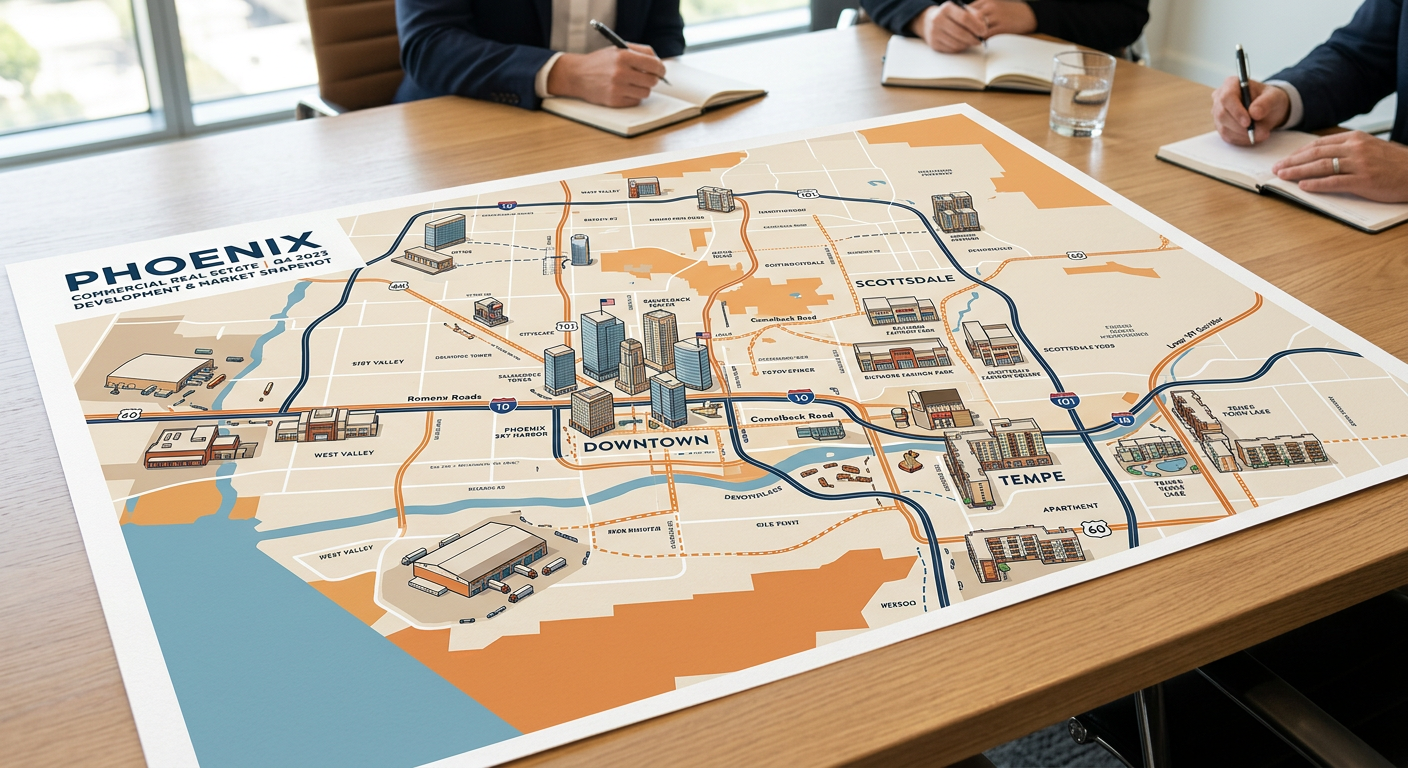
Industrial Remains a Major Source of Momentum
Industrial demand is still one of the clearest signals in the Valley. Manufacturing expansion, semiconductor-related suppliers, distribution users, and data-intensive operations are supporting activity in the West Valley, Northwest Phoenix, and selected Southeast Valley locations.
According to the Colliers Phoenix Industrial Market Report for Q2 2026, industrial vacancy fell to 8.7%, while quarterly net absorption reached 4.29 million square feet. The report also noted 15.5 million square feet under construction, which means new supply still deserves careful attention even as tenant demand has improved. (colliers.com)
What industrial owners should watch
Owners and investors should look beyond metro-wide vacancy. A building’s clear height, loading configuration, power capacity, truck access, age, and proximity to transportation routes can matter as much as the headline market number.
- Large blocks of modern warehouse space have a different tenant pool than small infill industrial buildings.
- West Valley logistics growth is creating demand, but competition among new buildings can influence concessions.
- Southeast Valley owners should closely track competing deliveries and tenant move-outs.
- Older office campuses may gain value through industrial or mixed-use redevelopment potential rather than traditional office leasing.
For an acquisition or disposition, our Phoenix investment sales guidance can help frame the property’s income, buyer pool, and positioning before it reaches the market.
Office Recovery Is Real, but Quality Still Wins
The Phoenix office sector is showing improvement after a difficult adjustment period. Leasing has strengthened, vacancy has eased, and limited new construction is helping reduce the amount of available space. Still, this is a segmented market, not a blanket recovery for every building.
The Colliers Phoenix Office Market Report for Q2 2026 reported 402,169 square feet of positive net absorption during the quarter, direct vacancy at 14.2%, and no new office deliveries. Overall asking rents reached $30.88 per square foot, with Class A space at $34.92 per square foot. (colliers.com)
The widening gap between office assets
High-quality, amenity-rich buildings in established locations are better positioned to compete. Tenants are placing value on efficient floor plans, parking, technology infrastructure, nearby dining, access to executive housing, and a workplace experience that supports recruiting.
By contrast, older Class B and Class C assets may need a more active plan. That can include targeted tenant improvements, more flexible lease structures, repositioning, or evaluating adaptive reuse where zoning and economics support it.
For tenants, the current market can create leverage in certain submarkets, especially when a building has meaningful vacancy or competing nearby space. Our tenant representation services focus on comparing locations, evaluating lease economics, and negotiating terms that fit the business rather than simply filling square footage.
Retail Favors Everyday Needs and Strong Trade Areas
Retail has remained resilient where it is tied to household growth and daily routines. Grocery-anchored centers, restaurant pads, medical-adjacent retail, and convenience-oriented locations continue to benefit from repeat traffic.
A July 2026 Phoenix retail market summary published by Matthews Real Estate Investment Services placed retail vacancy at 4.7% and noted that average asking rents were up 4.8% year over year. The practical takeaway is simple: well-located retail space is limited, so site selection and lease negotiation matter. (colliers.com)
What this means for retailers and landlords
A retailer should not choose a site based on rent alone. We recommend weighing the full trade area, including rooftops, traffic patterns, co-tenancy, visibility, access points, parking, delivery needs, and nearby competition.
Landlords should also recognize that tenants are more sophisticated about those same factors. A realistic asking rent, a clearly defined tenant-improvement package, and a responsive deal process can make a meaningful difference when competing for a strong operator.
Businesses evaluating a new location can review our Phoenix leasing services for support with space identification, comparables, and negotiations.
Multifamily Has a Direct Link to Commercial Demand
Apartment fundamentals affect more than apartment owners. New residents create demand for restaurants, grocery stores, healthcare, services, office users, and neighborhood retail. In reverse, employment centers and retail amenities can make nearby rental communities and homes more appealing.
Nationally, the Colliers U.S. Multifamily Capital Markets Report for Q2 2026 found that net absorption of 152,856 units was more than double the 67,268 units delivered in the quarter. It also identified Phoenix as one of the Sun Belt markets where supply remains a near-term factor, reinforcing the need to study each submarket rather than rely on a metro average. (colliers.com)
Why residential buyers and sellers should pay attention
Commercial development is not a guarantee of home-price appreciation. However, nearby employment, improving retail services, infrastructure investment, and successful mixed-use projects can influence how buyers perceive a neighborhood over time.
For homeowners, the most useful approach is practical:
- Track major projects within a realistic drive time of your home.
- Consider whether the project adds jobs, traffic, amenities, or all three.
- Watch for zoning changes and planned infrastructure in growing corridors.
- Compare your neighborhood against nearby areas that already have similar commercial anchors.
We share ongoing local analysis through our Phoenix real estate research resources, which can help owners and investors connect broader market activity to a specific area.

Financing and Property Strategy Matter More Than Headlines
Even in improving sectors, financing can change the math. Buyers are examining debt terms, future capital needs, lease rollover, insurance, operating expenses, and property condition more carefully. Sellers who prepare these details early are usually better equipped to defend value during buyer due diligence.
For commercial buyers
Before submitting an offer, clarify the business plan. Is the opportunity based on stable in-place income, lease-up potential, redevelopment, owner occupancy, or a future sale? Each strategy calls for a different level of risk tolerance and a different underwriting approach.
For commercial sellers
A credible offering package should tell the story clearly. Organize leases, operating statements, capital expenditure history, rent rolls, property surveys, environmental records, and information about nearby developments. Then position the asset for the buyer most likely to value its strengths.
For owner-occupants and tenants
Compare the cost of staying, relocating, leasing, and buying. An owner-occupant may benefit from control and long-term equity, while a tenant may preserve flexibility by negotiating renewal options, expansion rights, or an early termination structure that protects the business.
Quick Takeaway
Phoenix commercial real estate is increasingly location-driven and property-specific. Industrial demand is firming, office is improving selectively, retail remains constrained in strong trade areas, and multifamily is working through supply while demand rebuilds.
For buyers, sellers, and tenants, the opportunity is in the details: the right submarket, the right building, the right lease structure, and a strategy that matches current demand instead of last cycle’s assumptions.
Questions We Hear About Phoenix Commercial Property
Which Phoenix commercial sector is strongest?
Industrial and neighborhood-serving retail currently show some of the clearest demand signals. That said, a strong sector does not make every property a strong investment. Building quality, location, tenant credit, lease terms, and competitive supply still drive results.
Is Phoenix office space becoming more attractive to investors?
Selectively, yes. Office leasing and occupancy measures have improved, particularly for quality space and desirable submarkets. Investors should remain cautious with older buildings that lack amenities, require significant capital, or face a weak tenant base.
Should a small business buy its building or lease it?
The answer depends on cash flow, growth plans, desired flexibility, financing, and how specialized the space needs to be. We recommend modeling both paths with realistic occupancy costs and an allowance for future expansion or relocation.
How do commercial projects affect nearby home values?
Projects that add employment, useful amenities, and well-planned infrastructure can improve a neighborhood’s appeal. Projects that increase congestion or create incompatible uses may have a different effect, so homeowners should evaluate the actual proposal and its location.
What should a seller do before listing a commercial property?
Start with organized records, a realistic opinion of value, an assessment of deferred maintenance, and a clear picture of the likely buyer. Early preparation gives us more time to solve issues before they become obstacles in a transaction.
Build a Clear Plan for Your Property or Location
The most important conclusion is that Phoenix remains a market of distinct opportunities, not broad assumptions. Whether we are evaluating a commercial investment, a lease decision, or the residential implications of a growing employment corridor, we focus on local evidence, transaction structure, and the goals behind the decision.
Thinking about buying or selling real estate in Phoenix?
Call 602-281-6202 or
contact us here
to get local guidance and a clear next step.
About Natan Jacobs
NatanJacobs.com is a Phoenix-based real estate resource from Vestis Group, helping buyers, sellers, and investors
navigate residential, multifamily, and commercial real estate across Arizona. We provide hands-on guidance, market insight, and transaction execution with a focus on clear strategy and real results.
Explore Services & Resources
- For Sale Listings
- Investment Sales
- Leasing
- Tenant Representation
- Research
- Cash Offer
- List My Property
- Contact
Talk With Us
Call 602-281-6202
Email info@vestis-group.com
Contact: https://natanjacobs.com/contact/