
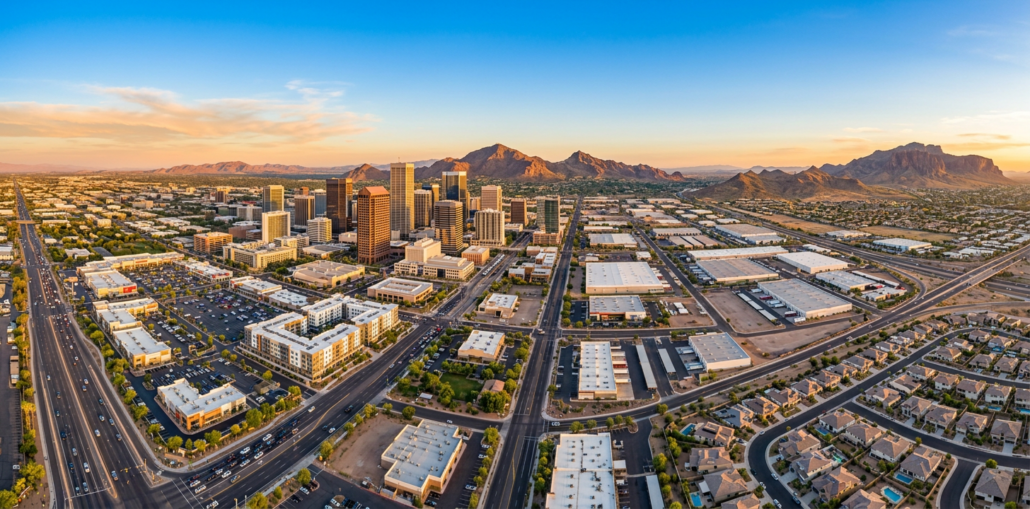
Phoenix Commercial Real Estate Trends: 2026 Outlook for Phoenix
Phoenix is still growing, but commercial property types are no longer moving in lockstep. Phoenix commercial real estate trends in 2026 point to a selective market: industrial demand is firming, quality office space is recovering, retail remains tight, and multifamily is beginning to work through its supply wave.
For home buyers, sellers, business owners, and investors, that distinction matters. Commercial development affects where jobs land, where retail follows new rooftops, and which Phoenix neighborhoods may see deeper long-term demand.
Phoenix Commercial Real Estate Trends Are Diverging
The central story is not broad-based acceleration or decline. It is a property-by-property and corridor-by-corridor recalibration, with tenant needs, available supply, and capital costs determining the winners.
| Property type | Current direction | What is driving it | What to watch |
|---|---|---|---|
| Industrial | Strengthening | Manufacturing, logistics, AI infrastructure | Large-block availability |
| Office | Recovering selectively | Flight to quality, shrinking inventory | Building quality and location |
| Retail | Tight | Household growth, grocery and service demand | New rooftops and traffic patterns |
| Multifamily | Rebalancing | Absorption improving as deliveries slow | Rent growth and occupancy |
The latest midyear analysis from Colliers describes a market supported by large corporate commitments, population growth, and renewed investment activity. That does not mean every building will perform equally. Older, poorly located, or functionally obsolete assets face a far different path than well-positioned properties with modern layouts and strong access.
For residential clients, this creates a useful filter. Areas near durable employment centers, daily-needs retail, and major transportation routes can benefit from commercial momentum, while neighborhoods dependent on a single project or speculative corridor deserve closer scrutiny.
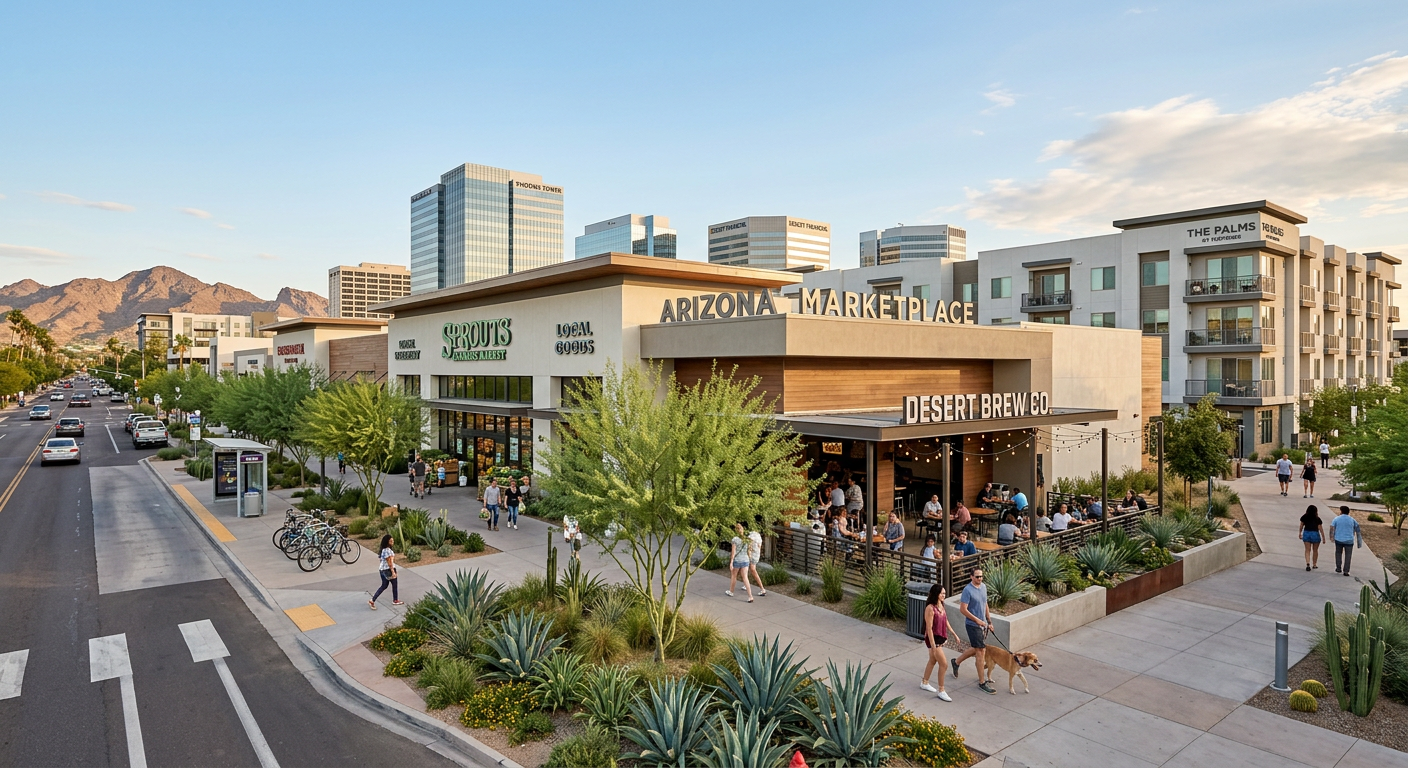
Industrial Is Regaining Its Footing
Industrial is one of the clearest positive signals in the Phoenix market, although lease terms and submarket selection remain critical. Demand has moved ahead of new deliveries, allowing vacancy to decline after the prior development cycle added substantial new space.
According to Colliers' Q2 2026 Phoenix industrial report, direct vacancy fell to 8.7%, while net absorption reached 4.29 million square feet during the quarter. The same report notes 9.1 million square feet of year-to-date absorption through the first half of 2026.
The West Valley and North Phoenix remain important
The Loop 303 corridor, Northwest Phoenix, and areas influenced by semiconductor and advanced-manufacturing investment continue to draw attention. Large users are looking for modern facilities, power capacity, freeway access, and labor access, not simply the lowest quoted rent.
The industrial story also reaches beyond warehouses. Suppliers, service companies, small manufacturers, retail tenants, and housing demand often follow large employment nodes. Buyers considering North Phoenix, Deer Valley, Peoria, Goodyear, Buckeye, Mesa, or Chandler should pay attention to the quality and permanence of nearby employment, not just the announcement headline.
What this means for owners and tenants
Industrial owners should protect strong occupancy but remain realistic about concessions, tenant improvements, and the competitive set. Tenants needing specialized power, loading, clear height, or large contiguous blocks should begin planning early because suitable options can narrow quickly.
For businesses evaluating relocation or expansion, our Phoenix tenant representation services can help compare locations based on operating needs, lease economics, and long-term flexibility rather than headline rent alone.
Office Is Recovering Through Quality and Conversion
Phoenix office is improving, but it is not a uniform comeback. Modern Class A buildings in amenity-rich locations are attracting demand while older campuses may be candidates for redevelopment, adaptive reuse, or repositioning.
Colliers' Q2 office report recorded 402,169 square feet of net absorption during the quarter and direct vacancy of 14.2%. It also reported that Phoenix office inventory declined by more than 800,000 square feet in the quarter as obsolete properties left the tracked stock.
Why the supply shift matters
A falling vacancy rate can result from growing tenant demand, reduced supply, or both. In Phoenix, both forces are present, but the removal and conversion of outdated office product is especially important. That makes a building's condition, parking, location, floor plate, and surrounding amenities more consequential.
Owners should avoid assuming that market improvement alone will solve an outdated asset's leasing challenges. A focused repositioning plan may be more valuable than waiting for general rents to rise. Buyers should separately underwrite the income in place, the cost of upgrades, and the potential alternative use of the site.
For an owner considering a sale, refinance, or repositioning decision, a conversation about investment sales advisory can clarify how comparable assets, buyer demand, and redevelopment potential may affect value.
Retail Follows Rooftops, Grocery, and Daily Routines
Retail continues to benefit from population growth and the everyday needs created by new housing. The strongest performance is generally concentrated in grocery-anchored centers, restaurant and service-oriented pads, and locations where residential density, traffic, and visibility reinforce one another.
The midyear Colliers report noted that Phoenix retail rents were up 5.9% year over year and that the construction pipeline had declined to 2.07 million square feet at midyear. A tightening development pipeline can support existing centers, but it does not make every retail site equally valuable. Access, co-tenancy, parking, signage, and neighborhood household growth still determine leasing strength.
Residential growth is a retail signal
For residential buyers and sellers, new retail can be a quality-of-life benefit, but context matters. A well-planned grocery, medical, dining, and service mix can make a neighborhood more convenient. High-traffic uses, late-night activity, or constant construction can affect the experience differently depending on the block.
We advise clients to look at the full pattern: planned housing, road improvements, schools, employment, retail anchors, and competing projects. That local context is more useful than treating any new shopping center as an automatic value driver.
Multifamily Is Moving From Supply Pressure Toward Balance
Multifamily remains relevant to commercial investors and residential clients because apartment performance influences renter demand, investor activity, and the broader housing ecosystem. Phoenix absorbed more units than it delivered in the second quarter of 2026, a meaningful change after a period of heavy construction.
Colliers reported that 5,692 units were absorbed in the second quarter, compared with 4,073 units delivered, with occupancy improving to 93.3%. That is encouraging, but it does not erase the impact of elevated supply in some submarkets or eliminate competition among landlords.
Investors should be disciplined about submarket supply
The right question is not whether Phoenix apartments are improving. It is whether a specific asset has the location, unit mix, amenities, rent position, and operating discipline to compete against nearby deliveries.
Smaller residential investors can apply the same thinking to single-family rentals, duplexes, triplexes, and fourplexes. New apartment supply may influence concessions and rent growth nearby, while job growth and limited for-sale inventory can support rental demand over the longer term. We recommend reviewing local rent comparables and active deliveries before setting a purchase price or renewal strategy.
How Commercial Activity Shapes Residential Decisions
Commercial growth can strengthen a residential area, but it should be evaluated as a demand indicator rather than a shortcut to predicting home values. Job centers, services, and infrastructure support buyer interest when they fit the character and daily needs of the surrounding neighborhood.
Here are the practical takeaways:
- Home buyers: Look for employment diversity, not just one major employer. Confirm commute routes, planned road work, and the timeline for nearby projects.
- Home sellers: Highlight genuine proximity to established services, major job centers, and lifestyle amenities. Avoid overpromising on projects that are still years from delivery.
- Residential investors: Compare lease-up competition, neighborhood rent growth, and tenant demand drivers at the ZIP code level.
- Commercial owners: Reassess asset positioning. A functional building in the right corridor may have several viable leasing or redevelopment paths.
- Business tenants: Start renewals and relocations early enough to negotiate concessions, build-out obligations, and expansion rights.
For ongoing local market context, visit our Phoenix real estate research resources. We use these broader commercial signals to help clients connect market activity with decisions on a particular property or neighborhood.
Frequently Asked Questions
Is Phoenix commercial real estate improving in 2026?
Yes, but improvement varies significantly by property type. Industrial fundamentals are strengthening, office is recovering selectively, retail remains comparatively tight, and multifamily is beginning to rebalance after substantial new supply.
Which Phoenix commercial sectors have the strongest demand?
Industrial and service-oriented retail have clear demand drivers, though the best opportunities are submarket specific. Office demand is more concentrated in modern, well-located buildings that meet current tenant expectations.
Does commercial development increase nearby home values?
It can support demand when it brings stable jobs, useful services, and well-planned infrastructure. It can also introduce traffic, noise, or construction impacts, so buyers should assess the exact project and its proximity to the home.
Are office buildings a good investment in Phoenix?
Some can be, especially well-leased assets in strong locations or properties with credible repositioning potential. Older office should be underwritten carefully because capital needs, leasing risk, and alternative-use feasibility can vary widely.
What should a commercial tenant negotiate besides base rent?
Tenants should focus on total occupancy cost, operating expense terms, tenant improvements, renewal options, expansion rights, signage, parking, permitted use, and assignment or sublease flexibility. The lease structure can matter as much as the starting rate.
Is the West Valley still a major commercial growth area?
Yes, the West Valley remains important for industrial, logistics, housing, and retail growth. Still, property performance will vary based on freeway access, labor availability, utility capacity, nearby rooftops, and the amount of competing space.
The Bottom Line for Phoenix Property Decisions
The strongest reading of Phoenix commercial real estate trends is selective confidence. Industrial demand, quality office recovery, retail resilience, and a more balanced apartment market all support the region's long-term case, but each decision still comes down to the asset, the submarket, and the lease or financing structure.
For buyers and sellers, commercial activity is most useful as a clue to where employment, convenience, and investment are concentrating. Pair that broader clue with neighborhood-level analysis before making a move.
Put Local Market Signals to Work
Thinking about buying or selling real estate in Phoenix?
Call 602-281-6202 or
contact us here
to get local guidance and a clear next step.
About Natan Jacobs
NatanJacobs.com is a Phoenix-based real estate resource from Vestis Group, helping buyers, sellers, and investors
navigate residential, multifamily, and commercial real estate across Arizona. We provide hands-on guidance, market insight, and transaction execution with a focus on clear strategy and real results.
Explore Services & Resources
- For Sale Listings
- Investment Sales
- Leasing
- Tenant Representation
- Research
- Cash Offer
- List My Property
- Contact
Talk With Us
Call 602-281-6202
Email info@vestis-group.com
Contact: https://natanjacobs.com/contact/