

Phoenix vs Scottsdale Real Estate Investment: Choose Wisely!
Choosing between two nearby cities can lead to very different investment outcomes. A Phoenix vs Scottsdale real estate investment decision is less about picking the better-known address and more about matching the property, financing, tenant profile, and exit plan to your goals.
Phoenix generally offers a lower entry point and a much wider range of neighborhoods, property types, and tenant demand. Scottsdale often requires more capital, but it can appeal to buyers looking for higher-income demographics, lifestyle-driven demand, and premium resale positioning. We recommend starting with the numbers, then narrowing the decision to a specific neighborhood and property.
Phoenix vs Scottsdale Real Estate Investment at a Glance
The core tradeoff is straightforward: Phoenix can offer greater flexibility and potential cash-flow support, while Scottsdale can offer a more premium buyer and renter profile at a substantially higher basis.
| Factor | Phoenix | Scottsdale | What It Means |
|---|---|---|---|
| Typical listing price | Lower | Higher | Phoenix may provide more entry options |
| Typical asking rent | Lower | Higher | Scottsdale rent can be stronger, but basis matters |
| Neighborhood variety | Very broad | More concentrated | Phoenix requires tighter submarket selection |
| Likely investment fit | SFR, small multifamily, value-add | Luxury rentals, condos, premium resale | Match strategy to location |
| Exit considerations | Broad owner-occupant pool | Higher-end buyer pool | Plan resale before buying |
In August 2026 market data, Realtor.com reported a median listing price of $449,900 and median monthly rent of $1,619 for Phoenix, compared with $899,000 and $2,409 for Scottsdale. Those are market-level asking figures, not a guarantee for any one property, but they show why purchase price discipline matters so much in this comparison.
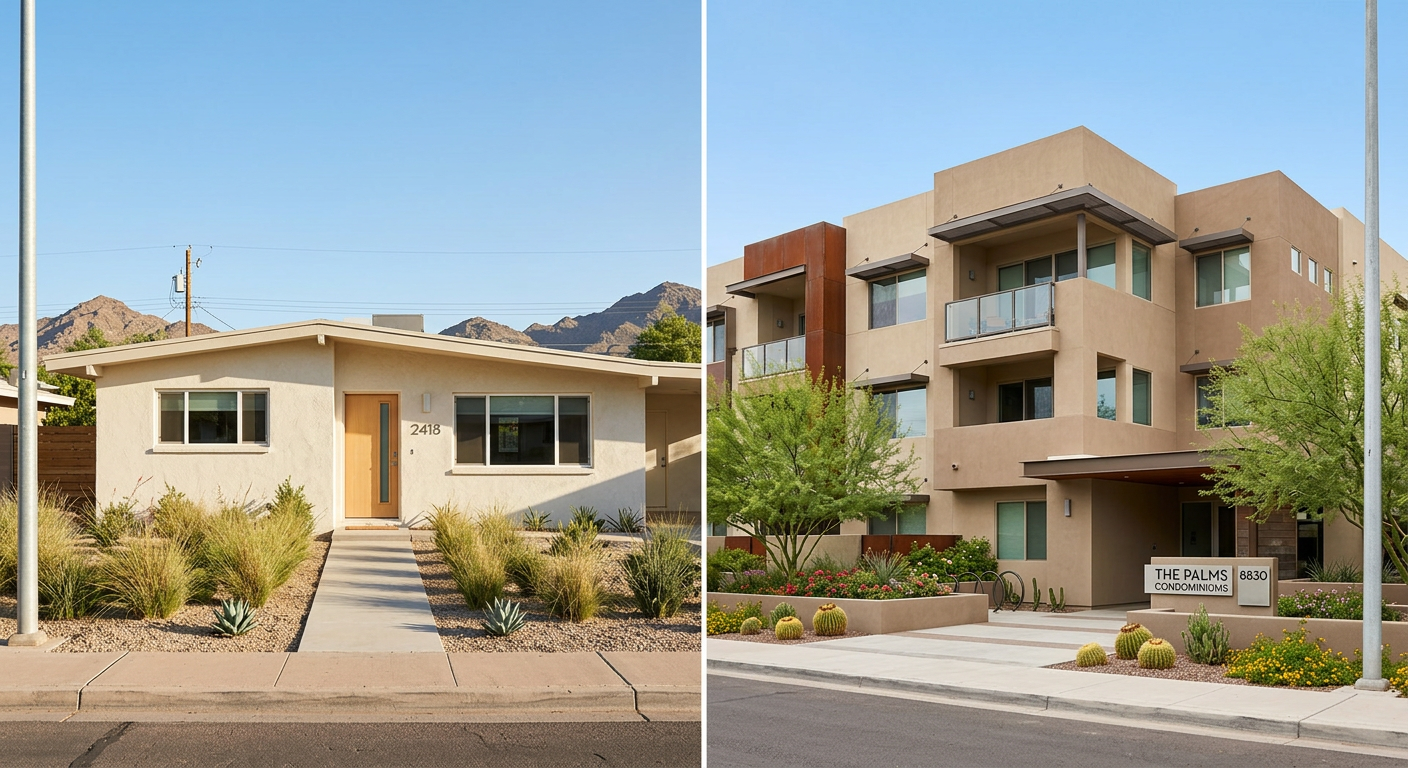
Start With the Investment Plan, Not the City Name
The better city is the one that supports your intended hold period, income target, risk tolerance, and eventual sale. Buying because an area feels prestigious or familiar is not a substitute for underwriting the actual property.
Phoenix Fits Investors Seeking More Entry Paths
Phoenix has a large physical footprint and a diverse housing stock. That gives investors more choices across single-family homes, duplexes, triplexes, fourplexes, condos, and infill opportunities, but it also means one ZIP code can perform very differently from the next.
Phoenix may be a stronger fit if we are looking for:
- A lower purchase-price threshold than many Scottsdale submarkets
- A long-term rental with broad local tenant demand
- A value-add home where renovation can improve rentability and resale appeal
- A small multifamily property with more than one income stream
- A future exit to an owner-occupant buyer, not only another investor
The scale of Phoenix also matters. The U.S. Census Bureau estimated Phoenix had 1,665,481 residents as of July 1, 2025. Its 2020 through 2024 median gross rent was $1,582, while the median value of owner-occupied homes was $420,700. Those figures reinforce a basic point: Phoenix is not one rental market. We need to assess each neighborhood's housing condition, employment access, school preferences, commute patterns, and competing inventory.
Scottsdale Fits Investors Pursuing a Premium Segment
Scottsdale can make sense for investors who have higher acquisition capacity and a clear plan for a premium property. Demand can be tied to lifestyle, golf, resort access, second-home ownership, proximity to employment centers, and a higher-income resident base.
The U.S. Census Bureau reports Scottsdale's 2020 through 2024 median household income at $110,886, compared with $81,332 in Phoenix. Its median gross rent was $2,013, but its median owner-occupied home value was also much higher at $789,800.
That spread is important. Higher rents do not automatically create better cash flow when the purchase price, financing, insurance, HOA fees, furnishing requirements, and maintenance costs rise at the same time.
Compare Price-to-Rent Before You Assume Scottsdale Wins
Higher rent is useful only when it supports the total cost of ownership. A Scottsdale property may command more rent, but an investor still needs sufficient income after debt service, reserves, vacancy, repairs, property taxes, insurance, management, and any HOA obligations.
Using the August 2026 market-level figures from Realtor.com as a simple screening exercise, Phoenix's annualized median asking rent of $19,428 is about 4.3% of its median listing price. Scottsdale's annualized median asking rent of $28,908 is about 3.2% of its median listing price.
This is not a cap-rate calculation, and it should never replace property-level underwriting. It does show why Scottsdale investors cannot rely on top-line rent alone. A premium market often demands a sharper acquisition price, a larger down payment, or a business plan centered on appreciation, personal use, resale appeal, or specialized rental demand.
Costs That Can Change the Answer
Before making an offer, we recommend building a conservative pro forma that includes:
- Principal, interest, taxes, and insurance
- HOA dues and transfer fees, when applicable
- Rental licensing or compliance requirements
- Property management and leasing costs
- Vacancy and turnover reserves
- Routine repairs and capital expenditures
- Landscaping, pool service, and utilities for higher-maintenance homes
- Furnishing and replacement costs for a short-term or seasonal rental strategy
For buyers evaluating condos or planned communities, review HOA financials and rental rules early. A property that looks compelling online can become a poor investment if lease restrictions, special assessments, or reserve shortfalls emerge during due diligence.
Neighborhood Selection Is the Real Decision
City boundaries matter, but the street, school district, condition, and nearby amenities often matter more. We advise investors to compare micro-markets instead of treating all Phoenix or all Scottsdale homes as interchangeable.
In Phoenix, a renovated home near major employment, hospitals, universities, established retail, or transportation access may appeal to both renters and future owner-occupants. In Scottsdale, proximity to Old Town, the Scottsdale Airpark, resort corridors, golf, hiking access, or highly regarded retail can influence both rent potential and resale demand.
A useful way to evaluate each candidate property is to ask:
- Who is the most likely renter or buyer?
- What competing properties will they choose instead?
- What features justify the rent or resale premium?
- Could the property still perform if rents soften or the sale takes longer?
- Is the exit pool broad enough for the price range?
For investors who want to compare available opportunities across property types, our Phoenix-area property listings can help identify homes, multifamily assets, commercial properties, and land opportunities in one place.
A Progressive Plan for Buyers, Sellers, and Investors
The best decision is rarely made in one step. We recommend progressing from city-level comparison to submarket review, then to property-level due diligence before committing capital.
Step One: Choose the Primary Outcome
Decide whether the property is intended for monthly income, long-term appreciation, future owner occupancy, redevelopment, or resale. A Phoenix duplex and a Scottsdale luxury condo can both be good assets, but they should not be judged by the same scorecard.
Step Two: Set a Downside Case
Use realistic rent, vacancy, repair, and financing assumptions. If the investment only works with perfect occupancy and an optimistic sale price, it needs more scrutiny.
Step Three: Build the Exit Plan Before the Offer
We want to know who may buy the property from us in three, five, or ten years. Phoenix often offers a broad owner-occupant and investor audience. Scottsdale can have strong demand in select price points, though the buyer pool may be more sensitive to luxury-market conditions and carrying costs.
Step Four: Match Professional Support to the Asset
A residential rental may call for neighborhood-level rental analysis and resale positioning. A small apartment building, retail property, or office lease requires different tools, including tenant mix, lease terms, operating statements, and site selection analysis. Investors considering a business location can review our tenant representation services for Metro Phoenix to understand how trade area, rent economics, and lease negotiations affect a commercial decision.
Owners weighing a direct sale, especially for a property needing repairs or a faster closing, can also review our Phoenix cash-offer option for qualifying properties before deciding which sales path fits their goals.
Frequently Asked Questions
Is Phoenix or Scottsdale better for a first-time real estate investor?
Phoenix is often more accessible for first-time investors because it offers more price points and property types. The right first investment should still have manageable repairs, a clear tenant profile, and enough reserves to handle vacancy or unexpected expenses.
Does Scottsdale offer better appreciation than Phoenix?
Not automatically. Scottsdale can benefit from premium positioning and lifestyle demand, but appreciation depends on the specific neighborhood, purchase price, property condition, and market cycle. We should avoid paying a premium solely because of the city name.
Are Scottsdale rentals easier to manage?
They can be, but premium rentals may require more attentive maintenance, stronger presentation, and higher tenant expectations. Homes with pools, landscaping, luxury finishes, and seasonal demand can require a larger operating budget.
Can a Phoenix property work as both a rental and a future primary residence?
Yes, and that flexibility can be valuable. We should verify the home's location, condition, layout, commute access, and likely appeal to future owner-occupants before relying on that exit strategy.
Should we buy a condo for investment in Scottsdale?
A condo can work when HOA rules, dues, reserves, rental restrictions, and financing requirements support the plan. Review the full association package before the inspection period expires, particularly if rental income is central to the investment case.
Is short-term rental income a safe reason to pay more for a property?
No. Short-term rental income can fluctuate with seasonality, competition, operating expenses, and local rules. Underwrite a conservative long-term rental alternative so the property is not dependent on one optimistic revenue assumption.
The Bottom Line
Phoenix and Scottsdale can both support sound real estate investments, but they reward different approaches. Phoenix may offer broader entry points, varied housing stock, and flexible rental or resale opportunities. Scottsdale may be a better fit for investors who can support a higher basis and have a specific premium-rental or lifestyle-driven resale plan.
The stronger choice is the property that still makes sense after we account for costs, competition, reserves, and the likely buyer or tenant at exit. Citywide averages are useful starting points, but successful investing happens at the neighborhood and property level.
Talk Through Your Next Property Decision
Thinking about buying or selling real estate in Phoenix?
Call 602-281-6202 or
contact us here
to get local guidance and a clear next step.
About Natan Jacobs
NatanJacobs.com is a Phoenix-based real estate resource from Vestis Group, helping buyers, sellers, and investors
navigate residential, multifamily, and commercial real estate across Arizona. We provide hands-on guidance, market insight, and transaction execution with a focus on clear strategy and real results.
Explore Services & Resources
- For Sale Listings
- Investment Sales
- Leasing
- Tenant Representation
- Research
- Cash Offer
- List My Property
- Contact
Talk With Us
Call 602-281-6202
Email info@vestis-group.com
Contact: https://natanjacobs.com/contact/