

What Is a Cap Rate in Phoenix Real Estate? Income, Risk, Value
A property can look attractive at first glance, with strong rents, a desirable Phoenix location, and a clean listing package. The real question is whether its income supports the price and risk involved.
When people ask what a cap rate is in Phoenix real estate, they are asking how much annual income a property produces relative to its value. It is one of the most useful starting points for comparing rental homes, duplexes, fourplexes, apartment buildings, and commercial properties, but it never tells the whole story by itself.
For buyers, a cap rate helps frame expected unlevered income before debt. For sellers, it helps explain why accurate financials, realistic expenses, and a credible operating story can directly affect value.
What a Cap Rate Means in Real Estate
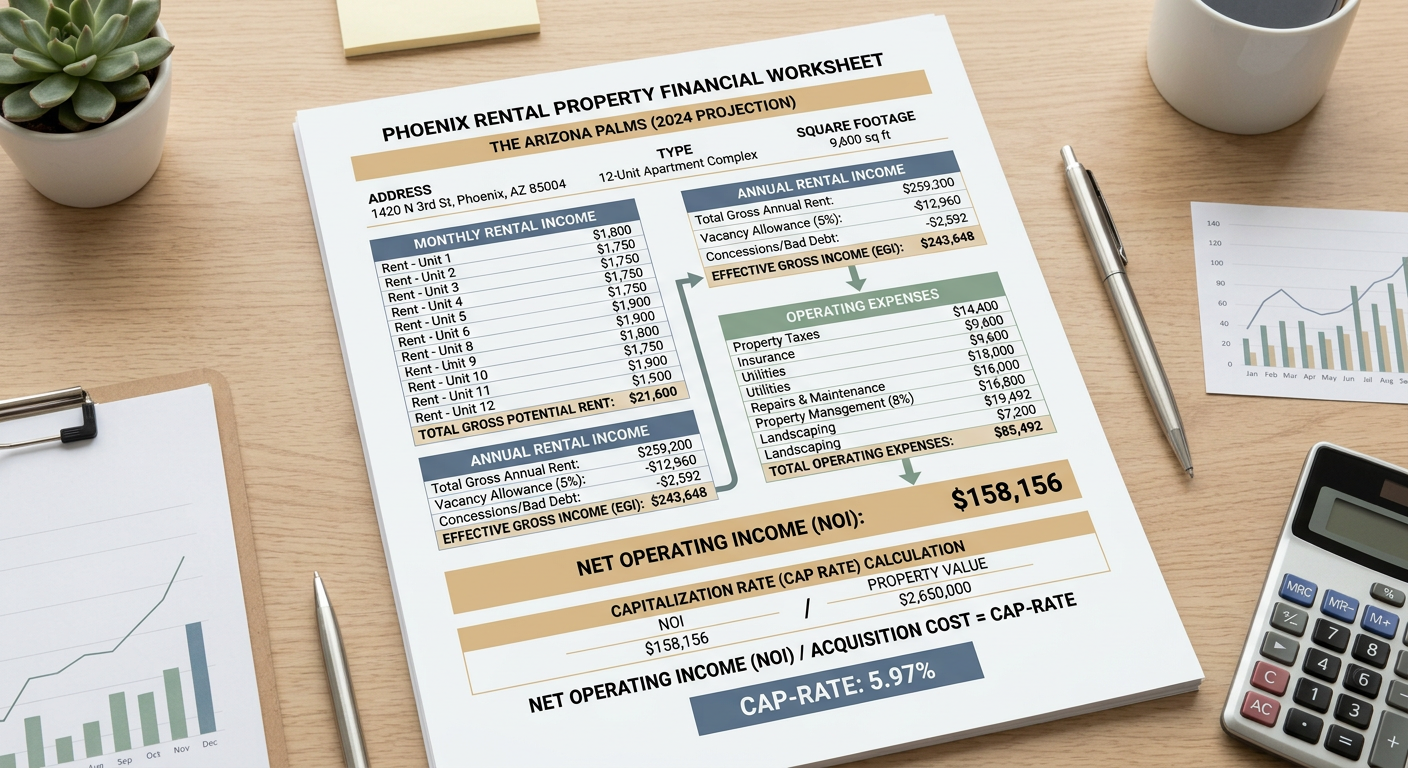
A capitalization rate, usually called a cap rate, measures a property's net operating income as a percentage of its purchase price or market value. It is a quick way to compare the income return of one investment property with another before financing is considered.
The formula is simple:
Cap Rate = Net Operating Income ÷ Purchase Price or Current Value
Net operating income, or NOI, is the property's income after normal operating expenses, but before mortgage payments, income taxes, depreciation, and major capital expenditures. In a small Phoenix rental, NOI commonly starts with collected rent and other recurring income, then subtracts vacancy, property management, repairs, utilities paid by the owner, insurance, property taxes, landscaping, and routine operating costs.
| Item | Example Amount |
|---|---|
| Annual collected income | $82,000 |
| Annual operating expenses | $22,000 |
| Net operating income | $60,000 |
| Purchase price | $1,000,000 |
| Cap rate | 6.0% |
In this example, the $60,000 NOI divided by the $1,000,000 purchase price equals a 6.0% cap rate. That does not mean the buyer receives a 6.0% cash-on-cash return, because loan payments, down payment size, closing costs, and future repairs still matter.
How Cap Rates Affect Phoenix Property Value
Cap rates and property values generally move in opposite directions when NOI stays the same. A lower cap rate supports a higher value, while a higher cap rate supports a lower value.
For example, a property producing $60,000 of stable NOI may be valued at $1,200,000 using a 5.0% cap rate. At a 6.0% cap rate, that same NOI points to a $1,000,000 value. The difference is substantial, which is why a buyer should not accept a listing cap rate without reviewing the underlying income and expenses.
A lower cap rate can reflect confidence
Lower cap rates are often associated with properties that have stronger locations, durable tenant demand, newer condition, stable occupancy, and lower perceived risk. A renovated rental in a highly desirable infill area may trade at a lower cap rate than a similar property farther from employment, amenities, or established demand drivers.
That does not automatically make the lower-cap-rate property the better purchase. Buyers may be paying more for reliability, future resale appeal, and perceived income stability. We compare the price premium with the property’s actual rent performance, deferred maintenance, lease quality, and nearby competition.
A higher cap rate can signal more income or more risk
A higher cap rate may create a stronger going-in yield, but it can also point to a reason the market demands more return. Older systems, elevated vacancy, weaker tenant credit, short lease terms, deferred maintenance, difficult management, or limited buyer demand can all push cap rates higher.
The right question is not, “Is this cap rate high enough?” It is, “Does this return adequately compensate us for the property’s real risks?” That distinction keeps buyers from pursuing a headline yield that disappears after repair costs, concessions, or rent losses are properly underwritten.
Phoenix Cap Rates Depend on Property Type and Location
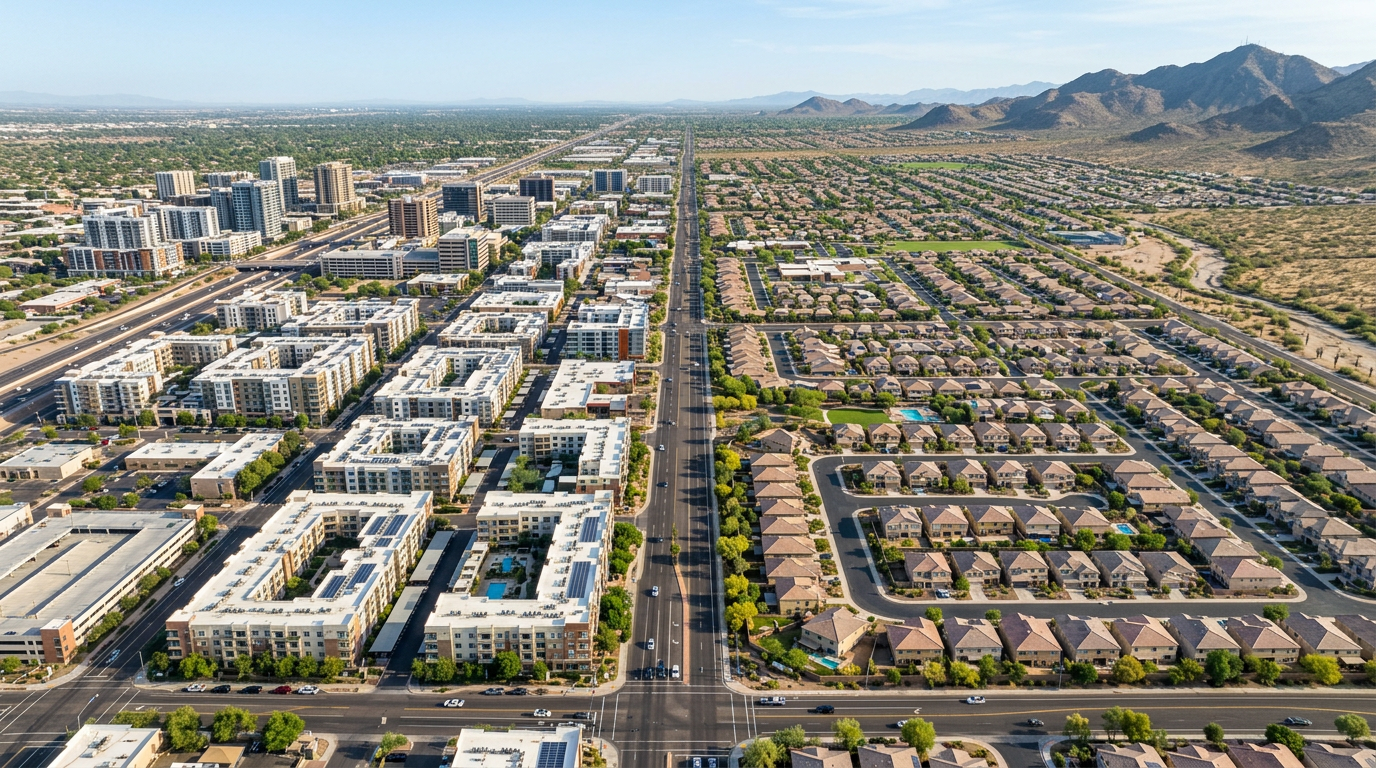
There is no single Phoenix cap rate that applies to every asset. Property class, condition, lease profile, tenant demand, submarket, and expected renovation costs can change the number significantly.
Recent market reports show why broad averages need context. In its first-quarter 2026 Phoenix multifamily update, Northmarq reported Class A apartment cap rates near 5.0%, while Class C properties generally ranged from 6.5% to 7.0%. In its second-half 2025 survey, CBRE showed Phoenix multifamily ranges of 4.75% to 5.25% across its Class A stabilized and value-add categories.
Those reports are useful benchmarks, not a substitute for valuing an individual property. They reflect different asset pools, time periods, and methodologies. A small fourplex with aging plumbing in central Phoenix should not be valued as though it were a newer, professionally managed Class A apartment community.
What can move a Phoenix cap rate
We look at factors that can materially alter the income outlook and risk profile:
- Location and access: Job corridors, schools, retail, transportation routes, and neighborhood appeal influence renter demand and resale liquidity.
- Property type: Single-family rentals, condos, duplexes, fourplexes, apartments, retail centers, and industrial buildings attract different buyer pools.
- Physical condition: Roofs, HVAC systems, plumbing, electrical equipment, pool systems, and parking areas matter more in Arizona’s climate than a quick walk-through may suggest.
- Income quality: In-place leases and collected rent are more meaningful than an aggressive projected-rent schedule.
- Expense accuracy: Insurance, taxes after a sale, utilities, maintenance, management, and vacancy reserves can materially change NOI.
- Future competition: New apartment deliveries, competing rentals, and concessions can limit rent growth in a specific trade area.
For more context on local supply, leasing conditions, and investor decision-making, review our Phoenix multifamily market report and our Phoenix multifamily investment guide.
The Cap Rate Mistakes That Change a Deal
A cap rate is only as dependable as the NOI used to calculate it. The most common error is treating a seller’s projected income as though it is already being collected.
Using pro forma income as current income
A pro forma cap rate assumes a future business plan succeeds. It may assume higher rents, fewer concessions, renovated units, improved collections, or reduced expenses. Those outcomes may be possible, but they are not the same as in-place performance.
We recommend calculating at least two cap rates: the in-place cap rate using current trailing financials, and the stabilized cap rate using conservative, supportable improvements. The gap between them tells you how much execution risk is embedded in the deal.
Forgetting major costs that are not in NOI
Mortgage payments are excluded from cap rate calculations, but so are major capital items such as a new roof, HVAC replacement, sewer-line work, or significant renovations. A property may show a favorable cap rate and still require near-term cash that materially reduces the return.
Before making an offer, we separate routine repairs from capital needs and obtain realistic bids where possible. This is especially important for older Phoenix properties, where systems may have endured years of extreme heat and heavy seasonal use.
Comparing different properties as if they are identical
A 6.5% cap rate on a small multifamily property may not be better than a 5.5% cap rate on a well-located single-family rental. The first could have higher management demands, deferred maintenance, and weaker tenant stability. The second could have more predictable demand and a broader owner-occupant resale audience.
For buyers evaluating residential income property, our Arizona small multifamily buying guide explains the due-diligence issues that matter for duplexes, triplexes, and fourplexes. For a broader comparison of asset types, see our Phoenix investment property strategy resource.
What Cap Rates Mean for Home Buyers and Sellers
Cap rates matter most to income-property buyers and sellers, but they can also help owner-occupants make smarter decisions. A buyer planning to live in one unit of a duplex or fourplex while renting the others should understand the property’s actual income, operating costs, and vacancy exposure.
For a primary residence with no rental component, comparable sales usually carry more weight than a cap rate. Still, an owner considering a future rental conversion can benefit from knowing whether local rents could reasonably support the carrying costs, maintenance needs, and desired investment return.
For buyers
A cap rate should help you screen opportunities, not replace underwriting. We recommend reviewing:
- Trailing 12-month income and expense statements
- Rent roll, lease expirations, delinquency, and concessions
- Comparable rents that reflect actual market competition
- Insurance quotes and expected post-sale property taxes
- Immediate repairs and longer-term capital needs
- Financing terms and cash reserves
For sellers
Sellers can improve confidence in a cap-rate analysis by presenting organized financial records, clean lease files, documented upgrades, utility history, and a clear explanation of any income upside. A buyer is more likely to support your pricing when they can verify NOI without making large assumptions.
If you own an income property and are considering a sale, strong records may matter as much as the property’s appearance. We can help owners frame the asset around current performance, credible upside, and the buyer profile most likely to value it correctly.
Quick Takeaway
A cap rate shows the relationship between a property’s net operating income and its value. In Phoenix, it is a useful way to compare investments, but it must be tied to real operating data, property condition, location, and the risks required to achieve projected income.
A lower cap rate can reflect stability and demand. A higher cap rate can offer more income, but it may also require more work, more capital, or more tolerance for vacancy and operational risk. The best decision comes from testing the numbers before committing to a price.
Common Questions About Phoenix Cap Rates
Is a higher cap rate always better?
No. A higher cap rate can mean stronger initial income, but it can also reflect greater uncertainty, deferred maintenance, tenant risk, or weaker resale demand. We compare the return with the risk and capital required to support it.
Does a cap rate include the mortgage payment?
No. Cap rates are calculated before debt service, so they do not account for your loan amount, interest rate, amortization schedule, or down payment. Cash-on-cash return and debt-service coverage are separate calculations that should be reviewed alongside the cap rate.
What is a good cap rate for a Phoenix rental home?
There is no universal target because rental homes vary by neighborhood, condition, tenant profile, and future resale potential. A good cap rate is one that matches the property’s actual risk, your financing terms, and your investment plan.
How do cap rates work for a duplex or fourplex?
The same formula applies, but small multifamily properties require closer review of each unit’s rent, utility setup, condition, parking, maintenance, and financing options. One vacant unit does not eliminate all income, which can be an advantage over a single-family rental.
Can I use a cap rate to value my primary home?
Usually not unless the home has a meaningful rental-income component. Owner-occupied homes are typically valued through comparable sales, buyer demand, condition, and location rather than NOI.
Why do the cap rate on a listing and my calculation differ?
The listing may use projected rents, exclude certain expenses, use a different price, or rely on a different operating period. Ask for the income statement, rent roll, and assumptions behind the calculation before relying on the figure.
The Bottom Line
Cap rates bring needed discipline to real estate investing because they force the conversation back to income, expenses, value, and risk. They are most powerful when we use them with property-level due diligence rather than as a shortcut.
In Metro Phoenix, the right cap rate is not a market-wide number to chase. It is the return that makes sense for a specific building, a specific location, realistic operations, and a clear plan after closing.
Put the Numbers in Context
Thinking about buying or selling real estate in Phoenix?
Call 602-281-6202 or
contact us here
to get local guidance and a clear next step.
About Natan Jacobs
NatanJacobs.com is a Phoenix-based real estate resource from Vestis Group, helping buyers, sellers, and investors
navigate residential, multifamily, and commercial real estate across Arizona. We provide hands-on guidance, market insight, and transaction execution with a focus on clear strategy and real results.
Explore Services & Resources
- For Sale Listings
- Investment Sales
- Leasing
- Tenant Representation
- Research
- Cash Offer
- List My Property
- Contact
Talk With Us
Call 602-281-6202
Email info@vestis-group.com
Contact: https://natanjacobs.com/contact/