
What Is Cap Rate in Commercial Real Estate? Income and Value
An asking price tells only part of the story when you evaluate an income-producing property. The income behind that price, the quality of the tenants, the expense load, and the future business plan can change the picture substantially.
For anyone asking what is cap rate in commercial real estate, the short answer is that it measures a property’s net operating income relative to its price or value. It is a useful first screen for a Phoenix retail building, small apartment community, office property, or industrial asset, but it is not a stand-alone measure of cash flow or overall deal quality.
What Is Cap Rate in Commercial Real Estate?
A cap rate, short for capitalization rate, is the percentage produced when a property’s annual net operating income is divided by its purchase price or market value. It helps buyers compare the income profile and perceived risk of similar commercial properties before debt is added to the analysis.
The formula is simple:
Cap Rate = Net Operating Income ÷ Purchase Price or Property Value
The NAIOP Research Foundation defines a cap rate as the initial unlevered income yield calculated from first-year expected net operating income and sales price. In plain language, it answers this question: how much operating income is the property producing for each dollar of value?
For example, a property with $150,000 in annual net operating income that sells for $2.5 million has a 6.0% cap rate.
| Item | Example |
|---|---|
| Annual gross income | $235,000 |
| Operating expenses | $85,000 |
| Net operating income | $150,000 |
| Purchase price | $2,500,000 |
| Cap rate | 6.0% |
This calculation gives you an income-to-price relationship. It does not tell you the down payment, loan payment, income-tax position, major future repairs, or how much cash lands in your account after financing.
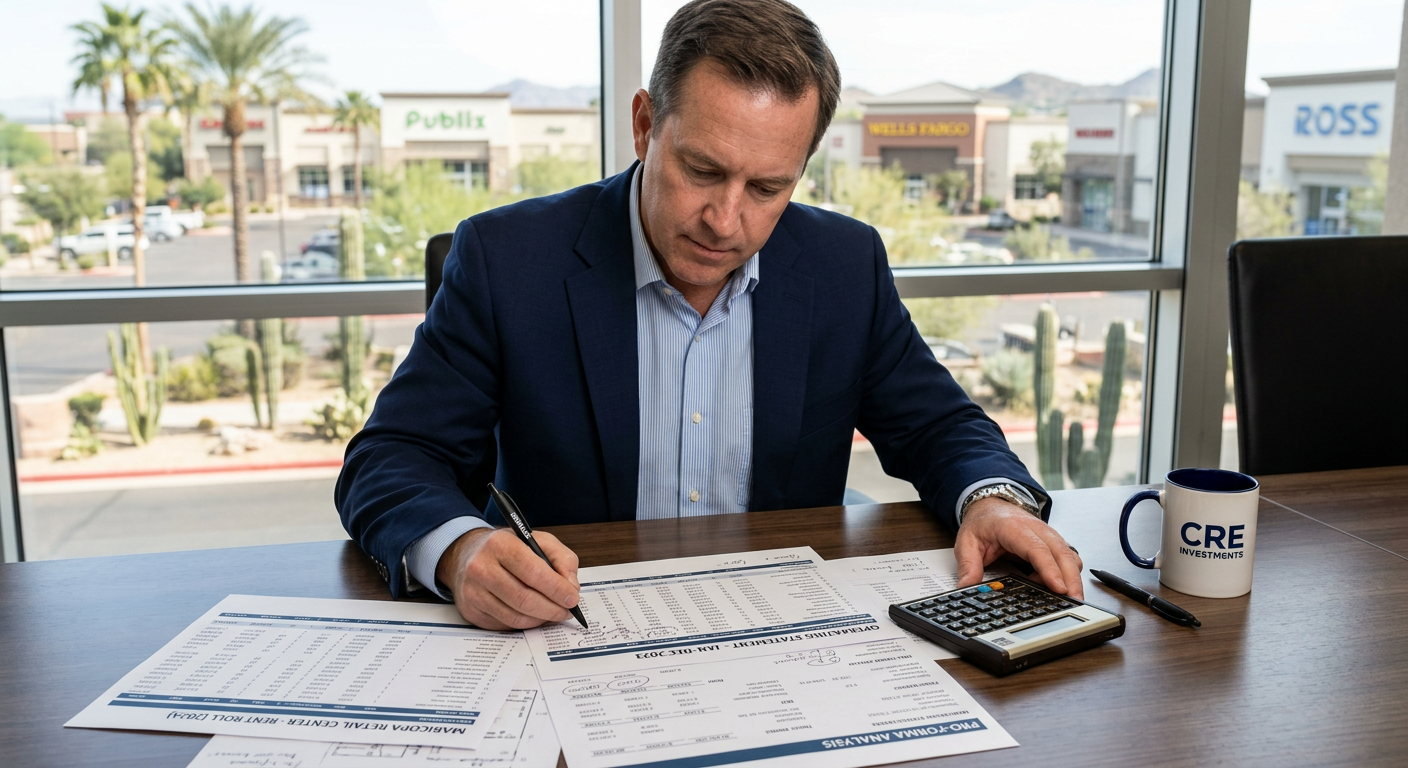
Net Operating Income Drives the Calculation
Cap rate is only as credible as the net operating income used in the formula. A seller’s stated number may be based on historical operations, a stabilized estimate, or an optimistic projection, so buyers need to identify exactly what income and expenses support it.
Net operating income, commonly called NOI, generally begins with collected rent and other recurring income. Then it subtracts normal operating costs, such as:
- Vacancy and credit loss
- Property management
- Property taxes
- Insurance
- Utilities paid by the owner
- Repairs and routine maintenance
- Landscaping, janitorial service, and common-area costs
- Leasing costs and recurring administration expenses
NOI is typically measured before mortgage payments, depreciation, income taxes, and major capital improvements. A new roof, replacement HVAC system, parking-lot resurfacing, or a large tenant-improvement package can materially affect a deal even if it does not appear in a simple cap-rate calculation.
That distinction matters in Phoenix. Two properties can show the same 6.0% cap rate, yet the one with aging mechanical systems, short tenant leases, rising insurance costs, or underwritten rent growth may carry far more risk than the cleaner asset.
Why Cap Rates and Commercial Values Move in Opposite Directions
When NOI stays the same, a lower cap rate points to a higher value and a higher cap rate points to a lower value. This inverse relationship is one reason even a modest cap-rate shift can have a major effect on pricing.
Using the same $150,000 annual NOI:
| Cap Rate | Indicated Value |
|---|---|
| 5.5% | About $2.73 million |
| 6.0% | $2.50 million |
| 6.5% | About $2.31 million |
A move from 5.5% to 6.5% lowers indicated value by more than $400,000 in this example, even though the building’s NOI did not change. That is why commercial owners should keep clean financial records and explain their property’s income durability before going to market.
A 2026 CBRE U.S. Cap Rate Survey drew on 3,600 cap-rate estimates across more than 50 U.S. markets. The report noted that property-specific factors, including location, quality, and asset characteristics, can push an individual property outside broad sector ranges. A headline market cap rate is useful context, but it cannot replace property-level underwriting.
A Higher Cap Rate Is Not Automatically Better
A higher cap rate can indicate a higher income yield, but it often signals that buyers see more uncertainty in the property. The right cap rate depends on the asset, its lease structure, the buyer’s plan, and the risks that must be managed after closing.
A lower cap rate may be associated with:
- A strong location near employment, housing, or high-traffic corridors
- Long-term leases with creditworthy tenants
- Consistent occupancy and well-documented income
- Newer construction or recently completed major repairs
- Lower perceived leasing and maintenance risk
A higher cap rate may reflect:
- Vacancy, upcoming lease expirations, or tenant concentration
- Deferred maintenance or capital needs
- A weaker location or limited buyer pool
- Short lease terms and uncertain renewal prospects
- Income that relies on aggressive projections
For a buyer, the productive question is not, “What is the highest cap rate available?” It is, “Does this cap rate compensate us for the actual risks, costs, and work involved?”
Phoenix Buyers and Sellers Should Underwrite the Story Behind the Number
In Phoenix, cap rate analysis should include more than a metro-wide average. We need to look at the specific submarket, access, parking, nearby competition, tenant demand, property condition, lease terms, and expense history.
This also applies to smaller residential investments. An owner-occupant considering a duplex or fourplex may use a cap rate to compare potential income, but financing options, unit condition, owner-paid utilities, and the ability to live in one unit can matter just as much. Buyers considering a larger apartment acquisition can review our guidance on buying a small multifamily property in Phoenix before relying on a marketing package alone.
For commercial investors, lease structure adds another layer. A triple-net retail asset and a multi-tenant office building can each show a 6.0% cap rate while carrying very different operating responsibilities. A tenant may pay many expenses in one deal, while the owner handles substantial common-area and maintenance obligations in the other.

How Buyers Can Use Cap Rate Without Getting Misled
Cap rate is most useful as a comparison tool and a starting point for deeper due diligence. We recommend recalculating NOI from source documents instead of accepting a listing’s headline percentage at face value.
Compare Like With Like
Compare similar property types in similar locations. A high-traffic infill retail building should not be measured against a remote warehouse or an older apartment property with a different tenant profile and expense structure.
Separate In-Place Income From Future Upside
A value-add deal may have below-market rents or vacancy that creates upside after renovation and leasing. That can be attractive, but it is different from buying stabilized income. Identify the going-in cap rate, the renovation budget, and the stabilized income scenario separately.
Stress-Test the Major Assumptions
Run scenarios for lower occupancy, slower rent growth, higher insurance, property-tax reassessment, leasing downtime, and major repairs. If a deal works only with perfect occupancy and no surprises, the margin for error is thin.
Pair Cap Rate With Other Metrics
Also evaluate debt-service coverage, cash flow after debt, cash-on-cash yield, lease expiration schedules, tenant concentration, replacement reserves, and likely resale conditions. For a broader framework, see our Phoenix investment property evaluation framework.
What This Means for Commercial Property Sellers
A seller cannot control every market condition, but strong preparation can improve buyer confidence. Buyers pay closer attention when the rent roll, trailing operating statements, leases, utility details, repair history, and capital improvements are organized and easy to verify.
If income is below market, explain the path to improvement with supportable comparable rents and a realistic timeline. If significant repairs are complete, document them. If a tenant has a long lease and a reliable payment history, make that strength easy to see.
This is especially important for multifamily owners. Cap rate, occupancy, expenses, and deferred maintenance all influence how buyers frame value. Our article on preparing a Phoenix multifamily asset for sale outlines the financial records and property details investors commonly review.
Quick Takeaway
Cap rate measures a commercial property’s NOI relative to its price or value. It can help buyers compare assets and help sellers explain value, but it does not replace a close review of leases, expenses, financing, future capital needs, and the property’s position in its local Phoenix market.
A strong deal is not simply the one with the highest cap rate. It is the one whose income, condition, risk, debt structure, and business plan fit your goals.
Frequently Asked Questions
What is considered a good cap rate in commercial real estate?
There is no universal good cap rate. A suitable cap rate depends on property type, location, tenant quality, lease length, condition, financing costs, and the buyer’s risk tolerance. Compare the asset with similar recent transactions, not a generic national benchmark.
Is cap rate the same as cash-on-cash yield?
No. Cap rate measures NOI against property value before debt, while cash-on-cash yield measures annual pre-tax cash flow against the actual cash invested. Financing can make the two figures materially different.
Does a cap rate include a mortgage payment?
No. Mortgage principal and interest are not included in a standard cap-rate calculation. This is why an asset with an appealing cap rate can still produce limited cash flow if debt costs are high.
Can a vacant commercial property have a cap rate?
A vacant property can be analyzed using a projected stabilized NOI, but it does not have reliable in-place operating income. Buyers should treat that scenario as a business plan, not as proven cash flow.
Why might two buildings with the same cap rate sell for different prices?
The buildings may have different NOI amounts. They may also differ in lease quality, tenant concentration, location, condition, financing appeal, or near-term capital needs. The same percentage does not mean the same risk profile.
Should residential investors use cap rate for a duplex or fourplex?
Yes, it can help compare income-producing properties, especially when one or more units will be rented. Owner-occupants should also weigh loan options, personal housing costs, repair responsibilities, and their plan for the property after they move.
Make the Number Work With the Full Deal
Cap rate is valuable because it forces attention toward income, value, and risk. Used well, it can help us identify when a property is fairly priced, when a seller’s assumptions need closer review, and when a seemingly attractive deal may require more caution.
For Phoenix investors, the best analysis starts with dependable operating data and ends with a realistic plan for ownership. Before making an offer or setting an asking price, make sure the number reflects the property you are actually buying or selling, not the one a projection assumes it will become.
Discuss Your Phoenix Real Estate Next Step
Thinking about buying or selling real estate in Phoenix?
Call 602-281-6202 or
contact us here
to get local guidance and a clear next step.
About Natan Jacobs
NatanJacobs.com is a Phoenix-based real estate resource from Vestis Group, helping buyers, sellers, and investors
navigate residential, multifamily, and commercial real estate across Arizona. We provide hands-on guidance, market insight, and transaction execution with a focus on clear strategy and real results.
Explore Services & Resources
- For Sale Listings
- Investment Sales
- Leasing
- Tenant Representation
- Research
- Cash Offer
- List My Property
- Contact
Talk With Us
Call 602-281-6202
Email info@vestis-group.com
Contact: https://natanjacobs.com/contact/